
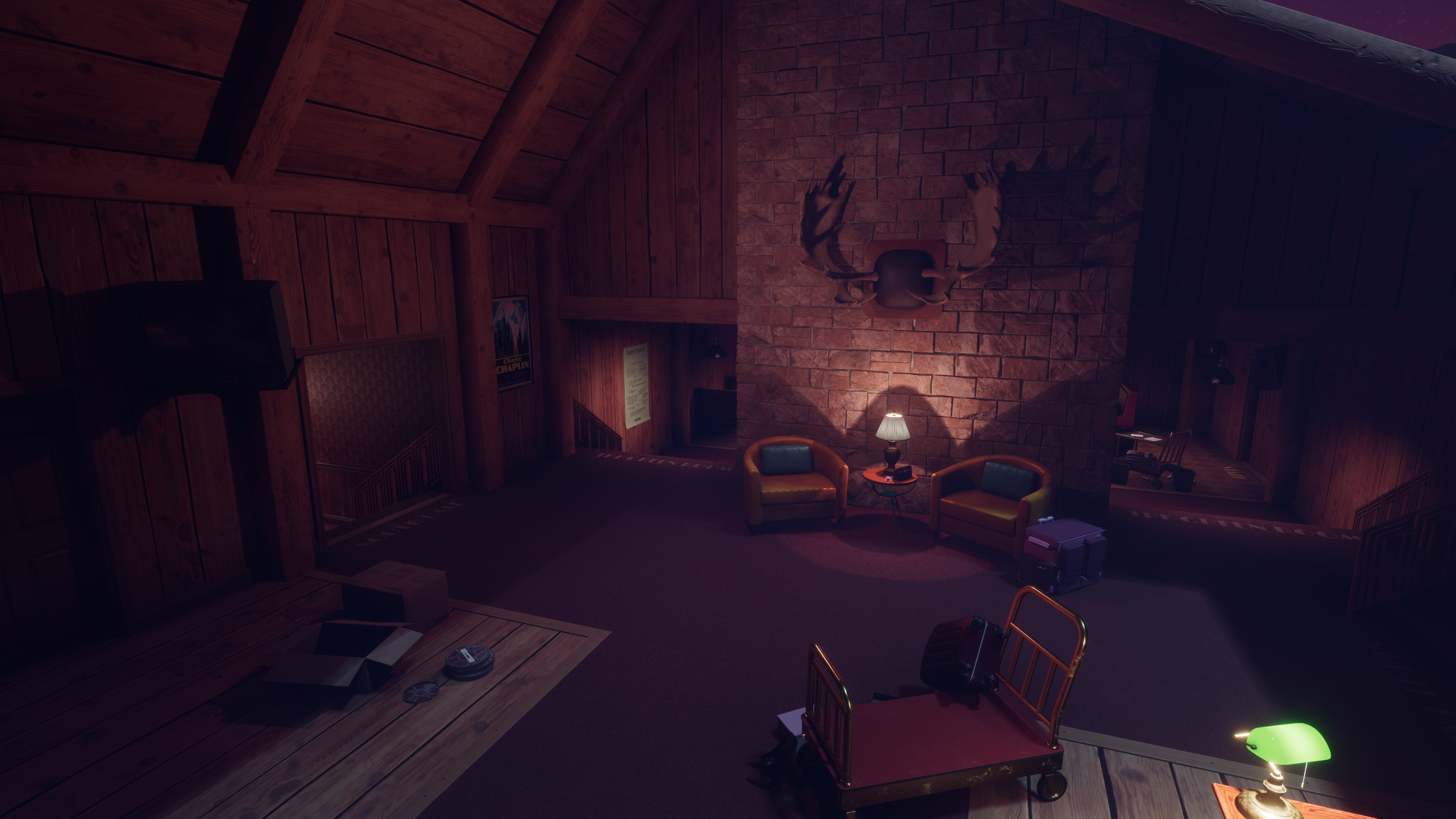
Welcome to our first DevLog for The Final Cut of Lilith Cunningham! Today, we’ve asked creative director Greg Rogers and art director Brianna Jenkins to share some new insights into how we’re building out the strange and mysterious Alpine Movie Manor Hotel and Drive-In.
But first… a BIG request from us (but something really simple you can do to help).
This week, The Final Cut of Lilith Cunningham was featured in the Minimap Indie Game Showcase: Mystery Edition! We shared our announcement trailer and a brand new video featuring The Host explaining just what’s going on in our game. If you haven’t had the chance to play our demo at PAX West or this weekend’s AdventureX in London, this is a great way to learn more about what draws Lilith to The Alpine Movie Manor and what happens once she arrives.
As part of our participation in the Minimap Indie Game Showcase: Mystery Edition, Causeway Studios has the opportunity to win free marketing support for The Final Cut of Lilith Cunningham. You can help us by casting a vote for us via the link below! The polls are open for two weeks, but we’d be grateful if you’d slide on over there right now and cast your ballot, then come back here for new info!
Now, onto the juicy stuff!
Whether you’ve played our demo or watched the announcement trailer to pick out every little clue, you’ve seen your first glimpses of The Alpine Movie Manor Hotel and Drive-In. Based on a real attraction in Colorado’s San Luis valley, our team is working to make The Alpine Movie Manor memorable from your first steps through the door to your last viewing of your very own Final Cut of the in-game short film.
BRIANNA JENKINS: The individual locations within the larger grounds have their own aesthetic tilts, but especially for the main hotel building, the primary inspiration is this lodge, americana, hotel/motel that you’d find in the middle of America. And then adding this flair of art deco that you might find walking into an old movie theatre that, in my head, was added by whoever created this strange place to add the “movie aesthetic”, to make it a draw for people; just to make it a little more interesting.
The Alpine Movie Manor is an exercise in contradictions. It features numerous places for patrons to gather, but retains that feeling of isolation you’d expect from a desert hotel.
GREG ROGERS: It’s the archetype of the roadside, lonely American motel. That’s the big drive. There’s more going on with it, it’s more of a hotel that has “motel” motifs to it, where you start with the mundane, but as you dig deeper into the space and the story, things begin to become stranger and more wonderful and more terrible – terrible in both usages of the world, as terrifying and awe-inspiring. How can this small space house such fantastical, supernatural elements?
For those that have played What Remains of Edith Finch? you’ll likely recall that sense of delight and awe, exploring huge, almost fantastical architecture that strains credulity and practicality. But at the same time, there’s a grounding in reality and humanity.
GREG: That’s what we wanted to capture through the aesthetics of The Alpine Movie Manor, where it’s both recognizable and also inspires curiosity. “Man, it’s kind of a place I’d like to go and visit, if only I didn’t have to contend with the preternatural dangers that may come up with the regrets that this place pulls me to solve (or not solve).” We’re going for that sense of one foot in Wonderland and one foot in the real world.
BRI: They key part of this is a feeling of nostalgia and timelessness. So, we’re pulling from different styles and different periods to create this larger sense of nostalgia, but it also makes the place feel like it’s a place out of time. You can’t quite place when it was built and there’s a mash-up of different technologies, which I think adds to the weirdness of it, but also ties into the themes really well.
The Alpine Movie Manor is more than just a roadside attraction, and it’s more than hotel with a drive-in theatre attached. Sure, cinephiles from all over come to stay at The Alpine Movie Manor, but it’s more than that to the local community. And the visual style is true to the region.
GREG: If you’ve ever been to the San Luis Valley, there are plenty of people there, but whenever you’re driving down those long highways, there’s just this awe-inspiring emptiness that you see because you can see so far, see the mountains on either side – the San Juan Mountains on the west and the Sangre de Cristo Mountains on the east – and it’s truly this strange, otherworldly feeling. It’s an interesting place. It draws people not just from the Valley itself, but from surrounding areas, too. It’s this really unique location that could stand on its own. But obviously, it has a lot more going on under the surface, which people will find out when they play the game, because there are attractions beyond the hotel.
I mean, in particular, you have the main hotel, but you also have the drive-in, which is an actual drive-in; this is actually self-sustaining in that you can actually drive a car up to it and watch a movie. And then you have the Lonely Emerald Lounge, which is this separate place that draws people for dining and culinary reasons, that draws them in to simply have a drink at the bar, or to listen to music at the Lounge and enjoy the performance of it all. Some people might come just for that and this weird mish-mashing of a beacon in what is not a highly populated area in the San Luis Valley.
BRI: I enjoy it a lot, because it allows me to get a little campy, which is really fun. It’s thinking about how would this place create that kind of attraction experience for people, specifically thinking about the movie theme of it all, and kind of being able to recreate that for the player. What are the thematic bits that would be put in place in the design of the rooms? Or how would the drive-in be set up for that kind of experience? Really thinking through what the history of the place might be and how would people interact with the space if they were really to come to this place?
The intentional blend of visual aesthetics, our music from composer Gustavo Coutinho, and a detective mystery set in the San Luis valley inspired us to lean into the “desert noir” vibes. This style captures the magic and mystery of the landscapes and is steeped in mysticism, with a touch of the ominous and foreboding. The Alpine Movie Manor embodies all of these.
BRI: The most overt way that the player experiences the desert-noir style is just being able to view the surroundings. We have this campus that the player is going through, but pretty much in every location, you have these large windows that are viewing out into this desert landscape at dusk or a little later. You’re filled with this intense sense of loneliness and vulnerability and this really beautiful, moody atmosphere that being in the middle of the desert would evoke.
In more subtle ways, we’re pulling on the kinds of architecture that you might find in places like this. So, a little bit of that Americana, with a country tilt. We’re using materiality that you would find in a dive bar in the middle of America or in a motel anywhere in San Luis Valley in Colorado.
GREG: A lot of our inspiration, particularly for this game, comes from David Lynch and he loved Los Angeles. There are a lot of films and vibes and television shows that pull from that area. It’s taking that as a root, both the noir as an urban environment and its sprawl, but also the noir of being lonely, the noir of being out in this sublime open space of sky and desert and mountains and shifting that over to just enough of a different location in Colorado that we can use the language of visuals that tie to genres like noir and even neo-noir. It can be older, it can be newer, but being able to add in our own flair of “Okay, but what does it mean to be in the heart of the Colorado Rocky Mountains? What does that add to the vibe that you don’t get in that low desert in Southern California or Arizona? How does that influence the visual choices that augment what’s going on?”
We aren’t strangers to peculiar architecture intended to invoke a specific emotion. The Cunningham House featured in The Haunting of Joni Evers is an enormous, sprawling home that feels too large for one person. And yet, each element of the home tells a piece of the family’s story. It’s intentional, even if it seems impractical and unlikely. And while the two settings are wildly different from one another, the common thread of our design intent connects them.
GREG: The Cunningham house in The Haunting of Joni Evers is this makeshift thing. It started as this smaller, respectable house and over the generations (and because it’s situated in this magical locus that we may explore later), no one wanted to move away. It was built out over time to fill the needs of the family that lived there, and that’s why it feels particularly large and lonely. That story revolves around her being left behind and having to move through this universe of a house that holds all of these memories and histories and things like that.
With the Alpine Movie Manor, that’s even more so, because this is not a person’s home – this has existed for many decades prior to the beginning of this game, and it will exist for many decades after. There are probably five to ten stories off the top of my head that we could go and tell about what occurred and what happened here. Some may pop up as little vignettes as you’re playing the game, others will remain unknown. The Hotel is seemingly mundane, but also a glimpse into Wonderland, in a noir, filmic way, there’s going to be strange elements of, “Who built this? Why did they choose these motifs? What are all these strange symbols and hidden rooms and hidden solutions?” Or, nothing nefarious, the quirks of someone who may build a hotel in this location that became successful that has this supernatural draw to it. So you never know what you might find, but nothing is what it seems in the Alpine Movie Manor Hotel and Drive-In.
BRI: I think the player will find themselves rewarded as they dig deeper. As Greg said, maybe there are some hidden rooms, maybe some tunnels, who knows?
GREG: Maybe some ladders?
BRI: Yeah, maybe you can move in ways that you didn’t in Joni, maybe we’ve added some of that. But also, when you add in the reality bending of it all, I think it gets a little more complex and a little bit more interesting in the ways that you can explore, compared to Joni.
GREG: I think one of the things that we want to do, at least as a design goal, is we want to create a space that you become familiar with. There’s a sensibility of the game where you will be returning to places and there will be places that you will walk past at the beginning of the game that you don’t have access to. The design goal is: if there’s a room, or a place on campus, you can go to it eventually. Nothing is a door that is simply there to explain a place that is bigger or make it feel bigger than it really is. We want it to be an area that, by the time you reach the end of the game, you will have had at least the opportunity to visit all of the locations. Sometimes you might not be able to get to every location, or every permutation of that location, based on the choices that you make, but hopefully that will make meaningful choices feel even more impactful. And hopefully it will encourage the people that fall in love with the world to go back and give it another spin, to see what corners of this strange hotel haven’t been explored. What might that mean to me, the player, about my own internal story about the history and powers of this strange place?
Mysteries and magic await you when The Final Cut of Lilith Cunningham launches in 2027.